
Island Bet Jamaica review: licence, withdrawals and checks

A hypothetical withdrawal file
Imagine a Jamaican player has a pending withdrawal and is preparing a file before contacting support. The file contains the account email, transaction reference, deposit and withdrawal timestamps, requested amount, payment channel, identity documents submitted, and screenshots showing the account status. This is a practical example, not a report of a withdrawal made with Island Bet: no deposit, account or withdrawal test was performed for this review.
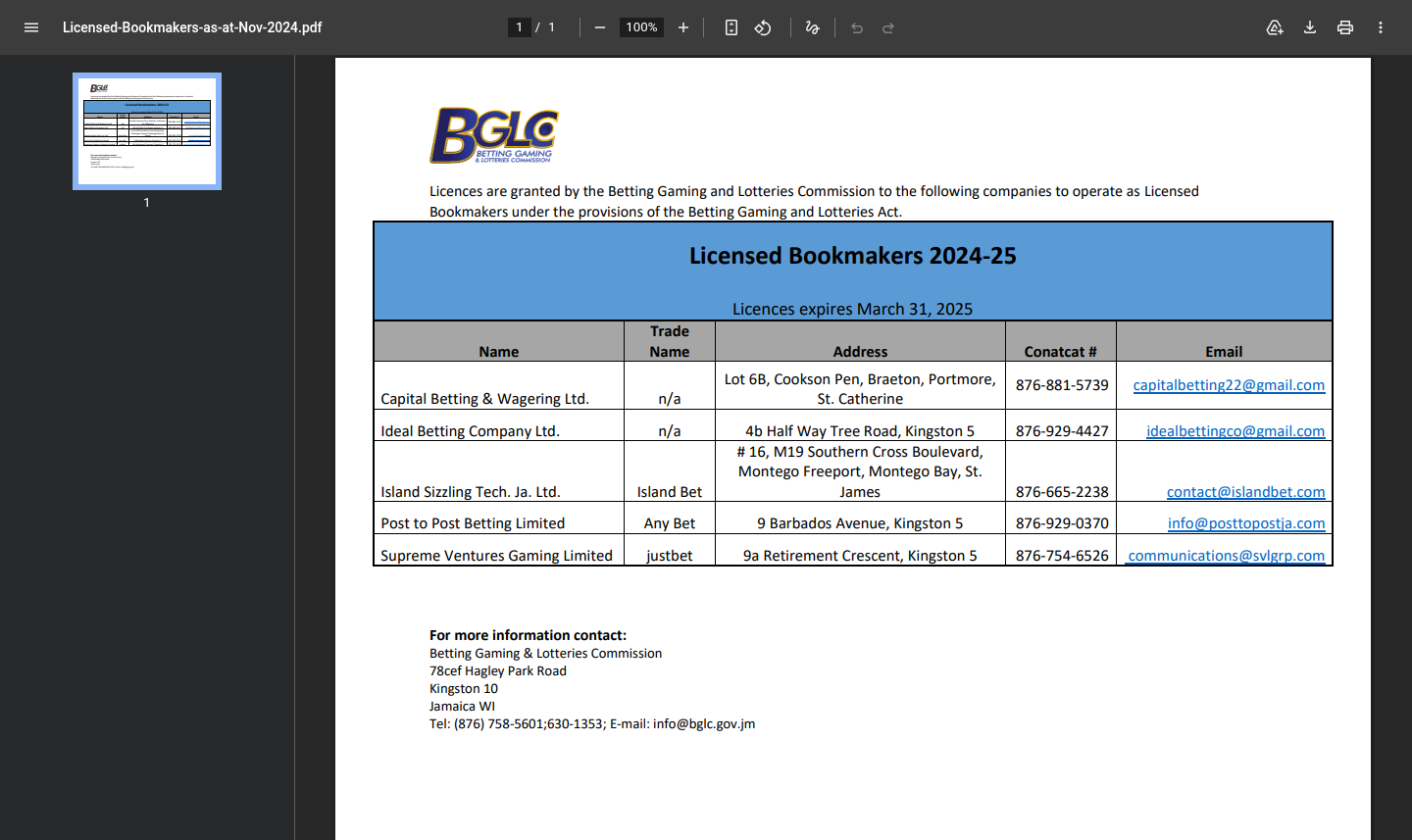
The sensible first question is not whether a payment delay proves wrongdoing. It is whether the player can identify the exact host, the responsible operator, the applicable terms and the route for escalation. The available record names Island Bet and Island Sizzling Tech. Ja. Ltd. in a Jamaica Betting, Gaming and Lotteries Commission (BG&LC) bookmaker list, but that list expired on 31 March 2025 and does not identify an exact licensed domain. That gap is why the overall signal is amber rather than green.
A payment file should therefore preserve evidence without making accusations. Save the relevant page addresses, dates, transaction references and support replies. Do not send additional identity documents through an unverified address. Redact passwords, one-time codes, full card numbers and unnecessary personal data before sharing material with anyone.
What the verified record establishes
The primary record is the BG&LC 2024–25 bookmaker list, checked on 24 August 2026. It names Island Bet and Island Sizzling Tech. Ja. Ltd., and provides an operator email. It expired on 31 March 2025. It does not establish that islandbet.com is the precise licensed domain, and it does not establish a current licence after that expiry date.
The source should be read as a dated historical licensing record, not as a current approval statement. The record is useful because it connects a brand name with an operator, but the domain mismatch remains material. A brand can be presented through more than one web address, and a familiar visual identity alone cannot prove that a particular host is authorised.
For the underlying record, consult the BG&LC bookmaker list in its dated context. The link is provided as evidence, not as a recommendation to use any operator.
| Check | Verified position | Practical meaning |
|---|---|---|
| Brand named in a BG&LC list | Island Bet is named | There is a historical brand-level record. |
| Operator named | Island Sizzling Tech. Ja. Ltd. | The record links the brand to an operator. |
| Record period | 2024–25 | It is not automatically current. |
| Expiry | 31 March 2025 | Current status needs separate confirmation. |
| Exact domain | Not supplied in the record | islandbet.com is not proven by this document alone. |
| Test transaction | None performed | Payment performance is unknown. |
Is the host the licensed service?
A host is the web address displayed in the browser and in account communications. Here, the exact recorded domain is islandbet.com. The verified licence record names the brand and operator but does not name that domain. This is an unresolved identity match, not proof that the host is unauthorised and not proof that it is authorised.
Before registering or depositing, compare the address in several places: the browser address bar, the login and payment pages, email links, the footer, account terms and any licence notice. Look for small changes such as extra words, hyphens, different endings, substituted letters or an unfamiliar redirect. A secure connection symbol is useful for protecting a connection, but it does not prove licensing or ownership.
The cached visual mark recorded for islandbet.com is evidence of a visual asset associated with the exact domain, not evidence of a licence. A clone can copy colours, wording and a logo. A genuine-looking page can still leave the operator-domain relationship unclear.
Licence and legal position in Jamaica
The available evidence supports a careful conclusion: a Jamaican regulator list dated for 2024–25 names Island Bet and Island Sizzling Tech. Ja. Ltd., but the list expired on 31 March 2025 and does not name islandbet.com. The available packet therefore does not verify a current licence for the exact host.
That is the reason for the amber signal. Green would require current primary evidence supporting the precise domain and entity. Red would require an official adverse record or corroborated documented evidence. Neither condition is established here. Amber means the evidence is open and the user should verify the current position before treating the service as legally available for the intended activity.
For legal wording and the statutory framework, read Jamaica’s Betting, Gaming and Lotteries Act. The Act’s official location is a source for the legal framework; it is not a finding about this particular host.
| Question | Current answer from the packet | What remains open |
|---|---|---|
| Is Island Bet named in a Jamaican bookmaker record? | Yes, in the supplied 2024–25 BG&LC list. | Whether the record remains current. |
| Is Island Sizzling Tech. Ja. Ltd. named? | Yes. | Whether it currently operates the exact host. |
| Is islandbet.com named in that record? | No. | The exact host-to-licence match. |
| Is a current licence expiry date supplied? | No; the listed record expired 31 March 2025. | Any later renewal or current authorisation. |
| Is illegality established? | No. | Current regulator confirmation. |
Payments: what can and cannot be concluded
No deposit or payment test was performed. Consequently, there is no verified finding about supported payment methods, processing speed, fees, reversals, minimums, maximums or successful withdrawals. A payment icon, a cashier screen or a statement in an article would not by itself prove that every method works for Jamaican customers.
A cautious payment check begins before money is sent. Record the payment method displayed at checkout, the currency, any stated fee, the minimum and maximum, and whether the account name must match the payment account. Read the withdrawal conditions separately from the deposit instructions. A method that accepts deposits may not support withdrawals, and an intermediary may introduce additional verification.
Keep the first transaction small enough that a failure would not create an unaffordable loss. Never treat a bonus balance as cash until the applicable terms are understood. Do not pay a separate person who claims to unlock a withdrawal unless the charge is clearly documented in the operator’s official terms and independently verified; an unexpected release fee is a serious warning sign.
| Payment point | Evidence status | Safe interpretation |
|---|---|---|
| Deposit method availability | Not tested | Unknown for a Jamaican account. |
| Withdrawal method availability | Not tested | Do not assume deposit and withdrawal methods match. |
| Processing time | Not tested | No time promise is verified. |
| Fees or exchange costs | Not tested | Check the displayed terms before confirming. |
| Successful withdrawal | No test performed | No performance conclusion is available. |
Withdrawals and KYC
A withdrawal review should distinguish three separate events: the request being submitted, the request being approved, and the money arriving. A status such as pending or processed is not the same as a confirmed receipt in the player’s payment account. Preserve timestamps for each stage and ask support for a specific explanation rather than relying on a generic status label.
Know-your-customer checks can include identity, address, age, payment ownership and source-of-funds information. The packet does not state which documents this service requests, how long checks take, or whether any user completed them successfully. Do not infer those details from common industry practice.
If documents are requested, use only a verified account channel and check the privacy terms first. Cover irrelevant numbers where permitted, while leaving the information needed for matching visible. Do not share a password, authentication code or complete payment credentials. If an email address, message or page differs from the host used to open the account, pause and verify it independently.
| Withdrawal file item | Why it matters | What to retain |
|---|---|---|
| Request time | Establishes the start of the case | Confirmation page and timestamp |
| Amount and currency | Defines the disputed sum | Transaction record with sensitive details redacted |
| Account status | Shows whether review or payment is pending | Status screen and support wording |
| KYC request | Identifies the stated reason for delay | Exact request and submission date |
| Payment receipt | Separates approval from arrival | Provider reference or statement entry |
Complaint and escalation route
Start with the service’s support channel and make a concise written request. Include the account identifier, transaction reference, amount, date, payment method, the exact question and the remedy sought. Ask whether the case is pending KYC, payment processing, a terms review or another stated reason. Set a reasonable response deadline and keep every reply in one case file.
Do not describe an unresolved delay as theft or fraud. A complaint is an allegation unless a dated competent-source record establishes otherwise. Do not publish another person’s identity documents or private account information when seeking help.
If the issue remains unresolved after first raising it with the vendor, the Consumer Affairs Commission (CAC) accepts unresolved consumer complaints. Its portal is the CAC complaint service. The CAC record supplied here establishes the escalation condition, not the outcome of any complaint about this service.
| Stage | Action | Record to keep |
|---|---|---|
| 1. Identify | Confirm the exact host and account details | Address, date and account reference |
| 2. Ask | Request a written reason and next step | Message, reply and deadline |
| 3. Protect | Stop adding funds while the issue is unclear | Payment records and screenshots |
| 4. Escalate | Use the CAC route after first contacting the vendor | Complaint submission and attachments |
| 5. Review | Update the file if a regulator or provider responds | Dated outcome and correction material |
Clone, redirect and impersonation checks
A clone check is a comparison exercise, not a visual guess. Type the known address rather than following an unsolicited message. Compare the host character by character, inspect where a login button leads, and check whether payment instructions suddenly refer to another entity. A different domain may be a legitimate service address, but it needs an explanation and evidence.
Treat urgent messages, unusual payment requests, requests for remote access and pressure to bypass normal verification as warning signs. Save the message headers or sender details where safe. Do not click a suspicious payment link merely to investigate it. Contact support through the independently entered host address, then compare the response with the published account information.
The packet includes a contextual Jamaica Observer item dated 18 June 2026. It provides context about brand activity or user-reported experience, but it is not proof of licensing, wrongdoing, safety or a typical outcome. It cannot close the domain-to-licence gap and should not be used as a substitute for a regulator record.

Continue only after checking →
Risks, limits and unknowns
The central risk is not a proven adverse finding; it is the open evidence around current status and exact host identity. The historical list is useful but expired. The operator is named, but the domain is not. Payment, KYC and withdrawal performance are untested. Contextual reporting may describe activity or an individual experience, but it cannot establish what normally happens to customers.
The following points remain unknown from the packet: a current licence or renewal, the precise licensed domain, the current terms, available Jamaican payment methods, withdrawal processing times, KYC requirements, complaint outcomes, account restrictions and the identity of any later operator. Unknown does not mean negative. It means a decision should not rely on an assumption.
Use the site’s published conditions only after checking that the host is the intended one. Pay attention to jurisdiction, age, identity, bonus, dormant-account, payment and withdrawal clauses. If the wording conflicts with the regulator record or the account communication, preserve both versions and seek clarification before continuing.
How this review was assessed and corrected
The assessment gives priority to the dated primary BG&LC record for the brand and operator. It then separates the official statutory location and CAC escalation information from operator-associated visual material and user-context reporting. No unverified statement was converted into a fact, and no transaction was simulated or tested.
The amber signal can change only when stronger, current evidence resolves the precise point at issue. Useful correction material would include a current BG&LC record that names the exact domain and operator, or a dated primary confirmation that clearly connects islandbet.com with the current authorisation. A later adverse official record could also change the assessment.
Send correction evidence through the correction contact route, identifying the claim, source, date and precise host. General assertions, copied promotional text and undated screenshots are not enough to establish a correction. The evidence ledger should retain the old position, the new source and the date of review so readers can see why the signal changed.
Bottom line for Jamaican players
The packet supports a historical connection between Island Bet and Island Sizzling Tech. Ja. Ltd. in a BG&LC bookmaker list, but that list expired on 31 March 2025 and does not name islandbet.com. There is no verified payment or withdrawal test. The most accurate conclusion is therefore amber: do not treat the exact host as currently verified from this evidence alone.
If you choose to investigate further, confirm the current host-to-operator-to-licence chain first, read the withdrawal and KYC terms, preserve a complete transaction file and avoid sending money while the identity or legal status remains unclear. For a broader explanation of how records are assessed, see the licence-check guide. If you decide to visit the recorded service, use the supplied route only after making your own current checks: Use the separated play route →.
Frequently asked questions
Is Island Bet licensed in Jamaica?
The supplied BG&LC 2024–25 bookmaker list names Island Bet and Island Sizzling Tech. Ja. Ltd., but the list expired on 31 March 2025. It does not name islandbet.com, so a current licence for the exact host is not verified by this record.
Is islandbet.com the licensed Island Bet domain?
The packet identifies islandbet.com as the exact domain under review, but the supplied licence record does not state that domain. The host-to-licence match is therefore open and should be checked against a current primary regulator record.
Has a withdrawal from Island Bet been tested?
No. No deposit, account or withdrawal test was performed. Processing times, payment methods, fees, KYC duration and successful receipt of funds are consequently unknown.
What should I do if a withdrawal is delayed?
Save the request time, amount, transaction reference, status and support messages. Ask the vendor for a written reason and next step. If the matter remains unresolved after first contacting the vendor, consider the CAC complaint route, while keeping allegations separate from established findings.
Does the Jamaica Observer context prove that the service is safe?
No. The supplied article is contextual information about brand activity or a user-reported experience. It is not proof of licensing, wrongdoing, safety or a typical customer outcome.
How can I check for a fake Island Bet host?
Compare the browser address with the exact recorded domain, type the address independently, inspect login and payment redirects, and watch for altered spelling or unexpected payment instructions. A matching logo or secure connection does not prove authorisation.
Why is the review signal amber?
Amber reflects open evidence: the historical regulator list names the brand and operator but is expired and does not identify the exact domain. There is no official adverse finding in the packet, but current precise-domain authorisation and transaction performance are not verified.